
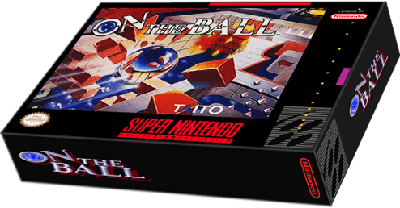
On the Ball
Descripción
There's a kind of knick-knack you may find in dusty games rooms, a maze through which you navigate a marble by subtly tilting the board, dancing with gravity and momentum, deftly rolling your sphere out of dead ends and around the obstacles posed by holes in the board. Marble madness explores this theme in a fudged 3-d perspective, cloud kingdoms in a flat 2-d one -- both by directly influencing the actions of the ball. The game takes a different approach toward a similar end; instead of moving the ball around the board, you move the board around the ball. That's right; from the get-go, gravity pulls ever down, down, down on your ball toward the bottom of your screen regardless of board orientation; the task of the player is to rotate the board now clockwise, now counter-clockwise, to further a timely and unobstructed path beneath the ball in its progress toward each level's goal before the timer ticks down to zero. The game might as well have been named "inertia." many obstacles can be avoided, but some must be engaged head-on: a certain momentum, if not terminal velocity, must be achieved to break through crumbling brick barriers; other obstacles toggle on and off like traffic lights, demanding not only speed but timing. Some influence the ball's direction, and in addition to merely delaying the ball's progress, touching some impediments incurs an additional time penalty -- conversely, some blocks bestow time bonuses, if you can afford the ever-diminishing time needed to take the scenic detour and collect them. It may seem like a transparent attempt to cobble together a game around a technical demo of the snes' mode 7 on-the-fly graphics-rotation capabilities, but taito actually cooked up this kooky game interface two years earlier for an arcade release of this game. (now if only someone could explain the "camel" part - referencing the japanese title.)
There's a kind of knick-knack you may find in dusty games rooms, a maze through which you navigate a marble by subtly tilting the board, dancing with gravity and momentum, deftly rolling your sphere out of dead ends and around the obstacles posed by holes in the board. Marble madness explores this theme in a fudged 3-d perspective, cloud kingdoms in a flat 2-d one -- both by directly influencing the actions of the ball. The game takes a different approach toward a similar end; instead of moving the ball around the board, you move the board around the ball. That's right; from the get-go, gravity pulls ever down, down, down on your ball toward the bottom of your screen regardless of board orientation; the task of the player is to rotate the board now clockwise, now counter-clockwise, to further a timely and unobstructed path beneath the ball in its progress toward each level's goal before the timer ticks down to zero. The game might as well have been named "inertia." many obstacles can be avoided, but some must be engaged head-on: a certain momentum, if not terminal velocity, must be achieved to break through crumbling brick barriers; other obstacles toggle on and off like traffic lights, demanding not only speed but timing. Some influence the ball's direction, and in addition to merely delaying the ball's progress, touching some impediments incurs an additional time penalty -- conversely, some blocks bestow time bonuses, if you can afford the ever-diminishing time needed to take the scenic detour and collect them. It may seem like a transparent attempt to cobble together a game around a technical demo of the snes' mode 7 on-the-fly graphics-rotation capabilities, but taito actually cooked up this kooky game interface two years earlier for an arcade release of this game. (now if only someone could explain the "camel" part - referencing the japanese title.)
Il existe une sorte de bibelot que vous pouvez trouver dans les salles de jeux poussiéreuses, un labyrinthe à travers lequel vous parcourez une bille en inclinant subtilement le plateau, en dansant avec la gravité et l'élan, en faisant rouler adroitement votre sphère hors des impasses et autour des obstacles posés par les trous dans le plateau. Marble Madness explore ce thème dans une perspective truquée en 3D, les royaumes des nuages dans une perspective plate en 2D - les deux en influençant directement les actions de la balle. Le jeu adopte une approche différente vers une fin similaire ; au lieu de déplacer la balle autour du plateau, vous déplacez le plateau autour de la balle. C'est exact; dès le départ, la gravité tire toujours vers le bas, vers le bas, vers le bas de votre écran, quelle que soit l'orientation de la planche ; la tâche du joueur est de faire tourner le plateau tantôt dans le sens des aiguilles d'une montre, tantôt dans le sens inverse des aiguilles d'une montre, pour favoriser un chemin opportun et dégagé sous la balle dans sa progression vers l'objectif de chaque niveau avant que le chronomètre ne revienne à zéro. Le jeu aurait tout aussi bien pu s’appeler « inertie ». de nombreux obstacles peuvent être évités, mais certains doivent être affrontés de front : un certain élan, voire une vitesse terminale, doit être atteint pour briser les barrières de briques en ruine ; d'autres obstacles s'allument et s'éteignent comme des feux de circulation, exigeant non seulement de la vitesse mais aussi du timing. Certains influencent la direction de la balle, et en plus de simplement retarder la progression de la balle, toucher certains obstacles entraîne une pénalité de temps supplémentaire. À l'inverse, certains blocs accordent des bonus de temps, si vous pouvez vous permettre le temps de plus en plus réduit nécessaire pour faire le détour panoramique et les récupérer. Cela peut sembler une tentative transparente de bricoler un jeu autour d'une démo technique des capacités de rotation graphique à la volée du mode 7 de la Snes, mais Taito a en fait concocté cette interface de jeu loufoque deux ans plus tôt pour une version arcade de ce jeu. (maintenant, si seulement quelqu'un pouvait expliquer la partie "chameau" - en faisant référence au titre japonais.)
C'è una specie di ninnolo che potresti trovare nelle sale giochi polverose, un labirinto attraverso il quale navighi su una biglia inclinando leggermente la tavola, ballando con gravità e slancio, facendo rotolare abilmente la tua sfera fuori dai vicoli ciechi e attorno agli ostacoli posti dai buchi nella tavola. Marble Madness esplora questo tema in una confusa prospettiva 3D, i regni delle nuvole in una piatta 2D, entrambi influenzando direttamente le azioni della palla. Il gioco adotta un approccio diverso verso un fine simile; invece di muovere la palla attorno al tabellone, sposti la tavola attorno alla palla. Giusto; fin dall'inizio, la gravità spinge sempre più in basso, in basso, in basso la tua palla verso la parte inferiore dello schermo, indipendentemente dall'orientamento del tabellone; Il compito del giocatore è ruotare il tabellone ora in senso orario, ora in senso antiorario, per favorire un percorso tempestivo e senza ostacoli sotto la palla nel suo progresso verso l'obiettivo di ogni livello prima che il timer scenda a zero. Il gioco avrebbe potuto anche chiamarsi "inerzia". molti ostacoli possono essere evitati, ma alcuni devono essere affrontati frontalmente: è necessario raggiungere un certo slancio, se non una velocità terminale, per sfondare le barriere di mattoni fatiscenti; altri ostacoli si accendono e spengono come semafori, richiedendo non solo velocità ma tempismo. Alcuni influenzano la direzione della palla e, oltre a ritardare semplicemente l'avanzamento della palla, toccare alcuni impedimenti comporta una penalità di tempo aggiuntiva; al contrario, alcuni blocchi conferiscono bonus di tempo, se puoi permetterti il tempo sempre minore necessario per prendere la deviazione panoramica e raccoglierli. Potrebbe sembrare un tentativo evidente di mettere insieme un gioco attorno a una demo tecnica delle capacità di rotazione grafica al volo della modalità 7 di SNES, ma Taito in realtà ha inventato questa stravagante interfaccia di gioco due anni prima per una versione arcade di questo gioco. (ora se solo qualcuno potesse spiegare la parte "cammello" - riferimento al titolo giapponese.)
Consejos
- Ficha jugadores que se adapten al sistema táctico de tu entrenador.
- Gestiona tu club como un negocio real; la economía es lo más difícil.
Consulta los trucos y consejos completos y siempre actualizados de este juego en la app.
Descargar gratis en Google Play- Sign players who adapt to your coach's tactical system.
- Manage your club like a real business; The economy is the most difficult.
Consulta los trucos y consejos completos y siempre actualizados de este juego en la app.
Descargar gratis en Google Play- Recrutez des joueurs qui s'adaptent au système tactique de votre entraîneur.
- Gérez votre club comme une véritable entreprise ; L'économie est la plus difficile.
Consulta los trucos y consejos completos y siempre actualizados de este juego en la app.
Descargar gratis en Google Play- Ingaggia giocatori che si adattano al sistema tattico del tuo allenatore.
- Gestisci il tuo club come un vero business; L’economia è la più difficile.
Consulta los trucos y consejos completos y siempre actualizados de este juego en la app.
Descargar gratis en Google Play