
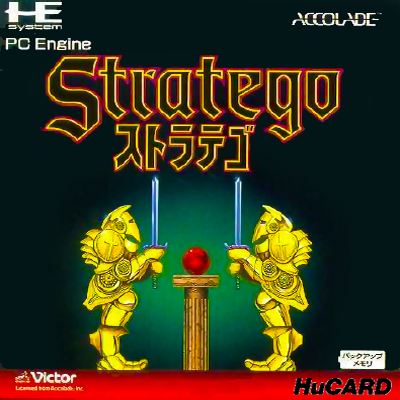
Stratego
Descripción
A video game adaptation of the famous strategic board game. Find the opponent's flag, and watch out for that spy. Overview: stratego is a board game adaptation that was originally published by accolade for various home computers in 1990. The game was also localized for a japanese audience with the pc engine release, which was published by victor entertainment in 1992. The game closely follows the rules of the classic stratego board game as conceived by creators jumbo, which was later licensed by milton bradley for north america. The game also offers various different modes, including a campaign mode which involves consecutive maps, as well as the option to change the visual design for the board and the pieces. Gameplay: the standard rules of stratego are as follows- the player must start the game by placing all forty units in the four rows on their side of the board. The player can move any of the numbered units or the spy (s) unit one space. The flag (f) and bombs (b) cannot be moved. No two units can occupy the same space. If an enemy unit and a player's unit meet, the one with the highest number (which correlates to a lower rank) is removed. The winning unit then moves into the empty space. If they have the same number, both are removed. If a unit touches the enemy's flag, they win the game. There are special rules governing a few of the units: the spy unit will be removed if attacked by anyone. However, they are the only unit that can defeat the highest ranked unit - the marshall, or #1. They can only do so if they are the attacker, not the defender. If any unit touches a bomb, they are removed from the board. The bomb does not move into the empty space. The miner (#8) is the only unit that can destroy a bomb. The scout (#9) can move any number of spaces horizontally and vertically.
A video game adaptation of the famous strategic board game. Find the opponent's flag, and watch out for that spy. Overview: stratego is a board game adaptation that was originally published by accolade for various home computers in 1990. The game was also localized for a japanese audience with the pc engine release, which was published by victor entertainment in 1992. The game closely follows the rules of the classic stratego board game as conceived by creators jumbo, which was later licensed by milton bradley for north america. The game also offers various different modes, including a campaign mode which involves consecutive maps, as well as the option to change the visual design for the board and the pieces. Gameplay: the standard rules of stratego are as follows- the player must start the game by placing all forty units in the four rows on their side of the board. The player can move any of the numbered units or the spy (s) unit one space. The flag (f) and bombs (b) cannot be moved. No two units can occupy the same space. If an enemy unit and a player's unit meet, the one with the highest number (which correlates to a lower rank) is removed. The winning unit then moves into the empty space. If they have the same number, both are removed. If a unit touches the enemy's flag, they win the game. There are special rules governing a few of the units: the spy unit will be removed if attacked by anyone. However, they are the only unit that can defeat the highest ranked unit - the marshall, or #1. They can only do so if they are the attacker, not the defender. If any unit touches a bomb, they are removed from the board. The bomb does not move into the empty space. The miner (#8) is the only unit that can destroy a bomb. The scout (#9) can move any number of spaces horizontally and vertically.
Une adaptation vidéoludique du célèbre jeu de plateau stratégique. Trouvez le drapeau de l'adversaire et faites attention à cet espion. Aperçu : stratego est une adaptation d'un jeu de société qui a été initialement publiée par accolade pour divers ordinateurs personnels en 1990. Le jeu a également été localisé pour un public japonais avec la version PC Engine, publiée par Victor Entertainment en 1992. Le jeu suit de près les règles du jeu de société Stratego classique tel que conçu par les créateurs Jumbo, qui a ensuite été autorisé par Milton Bradley pour l'Amérique du Nord. Le jeu propose également différents modes, dont un mode campagne qui implique des cartes consécutives, ainsi que la possibilité de modifier la conception visuelle du plateau et des pièces. Jouabilité : les règles standard du stratego sont les suivantes : le joueur doit commencer la partie en plaçant les quarante unités dans les quatre rangées de son côté du plateau. Le joueur peut déplacer n'importe laquelle des unités numérotées ou l'unité d'espionnage d'une case. Le drapeau (f) et les bombes (b) ne peuvent pas être déplacés. Deux unités ne peuvent pas occuper le même espace. Si une unité ennemie et l'unité d'un joueur se rencontrent, celle avec le numéro le plus élevé (ce qui correspond à un rang inférieur) est supprimée. L'unité gagnante se déplace alors dans l'espace vide. S'ils portent le même numéro, les deux sont supprimés. Si une unité touche le drapeau ennemi, elle gagne la partie. Il existe des règles spéciales régissant quelques-unes des unités : l'unité d'espionnage sera supprimée si elle est attaquée par quelqu'un. Cependant, ils sont la seule unité capable de vaincre l'unité la mieux classée : le marshall, ou n°1. Ils ne peuvent le faire que s’ils sont l’attaquant et non le défenseur. Si une unité touche une bombe, elle est retirée du plateau. La bombe ne se déplace pas dans l'espace vide. Le mineur (#8) est la seule unité capable de détruire une bombe. L'éclaireur (n°9) peut se déplacer d'un nombre illimité de cases horizontalement et verticalement.
Un adattamento videoludico del famoso gioco da tavolo strategico. Trova la bandiera dell'avversario e fai attenzione a quella spia. Panoramica: stratego è un adattamento di un gioco da tavolo originariamente pubblicato da accolade per vari computer domestici nel 1990. Il gioco è stato anche localizzato per un pubblico giapponese con il rilascio del motore per PC, pubblicato da Victor Entertainment nel 1992. Il gioco segue da vicino le regole del classico gioco da tavolo di stratego concepito dai creatori di Jumbo, che è stato successivamente concesso in licenza da Milton Bradley per il Nord America. Il gioco offre anche diverse modalità, inclusa una modalità campagna che coinvolge mappe consecutive, oltre alla possibilità di modificare il design visivo del tabellone e dei pezzi. Modalità di gioco: le regole standard di Stratego sono le seguenti: il giocatore deve iniziare la partita posizionando tutte le quaranta unità nelle quattro file sul proprio lato del tabellone. Il giocatore può muovere una qualsiasi delle unità numerate o l'unità spia di uno spazio. La bandiera (f) e le bombe (b) non possono essere spostate. Due unità non possono occupare lo stesso spazio. Se un'unità nemica e l'unità di un giocatore si incontrano, quella con il numero più alto (che è correlato a un grado inferiore) viene rimossa. L'unità vincente si sposta quindi nello spazio vuoto. Se hanno lo stesso numero, vengono rimossi entrambi. Se un'unità tocca la bandiera nemica, vince la partita. Esistono regole speciali che governano alcune unità: l'unità spia verrà rimossa se attaccata da qualcuno. Tuttavia, sono l'unica unità che può sconfiggere l'unità con il punteggio più alto: il maresciallo, o n. 1. Possono farlo solo se sono l'attaccante e non il difensore. Se qualsiasi unità tocca una bomba, viene rimossa dal tabellone. La bomba non si sposta nello spazio vuoto. Il minatore (#8) è l'unica unità che può distruggere una bomba. L'esploratore (#9) può muoversi di qualsiasi numero di spazi orizzontalmente e verticalmente.
Consejos
Consulta los trucos y consejos completos y siempre actualizados de este juego en la app.
Consulta los trucos y consejos completos y siempre actualizados de este juego en la app.
Consulta los trucos y consejos completos y siempre actualizados de este juego en la app.
Consulta los trucos y consejos completos y siempre actualizados de este juego en la app.