
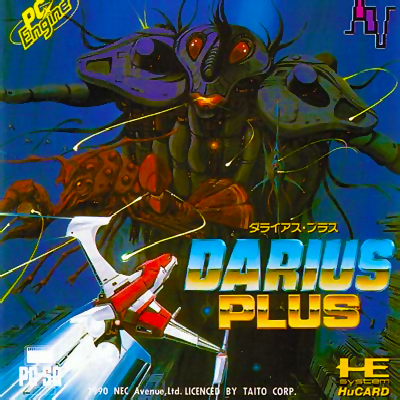
Darius Plus
Descripción
Amidst the clutter of arcade shooters in the late 1980s, companies needed to make their games stand out in some way. Simply flying a ship into outer space simply wasn't going to cut it anymore. Taito had an idea. Yes, there was still a spaceship. And yeah, that "outer space" part was still there too. But instead of the usual aliens, you fought fish. Yes, fish. Not even regular, aquatic fish, but robotic fish with lasers equipped to their fins, giant metal teeth and missiles firing from their gills. And not just fish either. There are squid, snails, and other undersea variations out for your blood as well. The requisite plot is about the people of the planet darius, who are being terrorized by said intergalatic fish. Only the heroic pilots proco jr and tiat young can save the day. The constant star of the darius series is the silver hawk. Much like gradius, it has a primary, forward firing weapon, along with bombs that can be used to attack vertically, and the usual shield. The arcade game darius games also used a unique system that attached three monitors together to create one massive horizontal playing field (also used in taito's ninja warriors.) naturally, this couldn't quite be replicated on the console system, so that nifty little gimmick is lost, but emulators can still replicate the dimensions of the screen, even if you end up looking at a tiny picture. Looking to further set itself apart from the crowd, every darius game has multiple levels, with several branching paths throughout the game. It adds tremendously to the replay value, especially since there are usual multiple endings, depending on which final zone you end up at. Darius is a two-dimensional horizontally scrolling shoot 'em up set in a fictional future. Uniquely among shoot 'em ups, the game's screen was three times wider than conventional size, and the arcade cabinet used an arrangement of three screens to accommodate it. The player controls an ornate fighter spacecraft, named the silver hawk, and must navigate through scrolling terrain while battling a variety of fighter craft, ground vehicles, turrets, and other obstacles throughout the game's stages (referred to as zones in the game). The ship's arsenal consists of forward-firing missiles, aerial bombs and a protective force field, all of which can be upgraded by power-ups (in the form of large, colored orbs) that are dropped by specially-colored enemies throughout the game's zones. When the player reaches the end of a zone, a boss appears, which must be defeated to proceed. Once the boss of a zone is destroyed, the player is given a choice of which zone to play next via a branching path. While there are 28 zones in total, only seven can be played in a single run. When various ports of it were made for different consoles, taito (and others) were forced to shrink the playfield to fit on one screen. It was released for the commodore amiga, atari st, pc engine, pc engine (super cd-rom), wii (virtual console), and zx spectrum. The pc engine saw three releases: darius alpha (1990): a very rare beta release. This is one of the rarest hu-cards ever published. You could only get a copy of this hardcore shoot-em-up by buying darius plus and super darius and then mailing coupons to the publisher. 800 copies were made available, and names were drawn from those who mailed their info in. Some copies of the game were also given away as prizes by pc engine gekken and marakatsu magazines. Darius plus (1990): the full game itself, again a pc engine hucard. The bosses that were removed in alpha do not return here. Both alpha and plus were actually written for the pc engine supergrafx and playing them on that console results in slightly improved graphics (less flicker and slowdown). Super darius (1990): a conversion of darius for the pc engine's super cd-rom, very close to the original arcade version other than being single-screen. Features new bosses, as well as a "boss rush" mode.
Amidst the clutter of arcade shooters in the late 1980s, companies needed to make their games stand out in some way. Simply flying a ship into outer space simply wasn't going to cut it anymore. Taito had an idea. Yes, there was still a spaceship. And yeah, that "outer space" part was still there too. But instead of the usual aliens, you fought fish. Yes, fish. Not even regular, aquatic fish, but robotic fish with lasers equipped to their fins, giant metal teeth and missiles firing from their gills. And not just fish either. There are squid, snails, and other undersea variations out for your blood as well. The requisite plot is about the people of the planet darius, who are being terrorized by said intergalatic fish. Only the heroic pilots proco jr and tiat young can save the day. The constant star of the darius series is the silver hawk. Much like gradius, it has a primary, forward firing weapon, along with bombs that can be used to attack vertically, and the usual shield. The arcade game darius games also used a unique system that attached three monitors together to create one massive horizontal playing field (also used in taito's ninja warriors.) naturally, this couldn't quite be replicated on the console system, so that nifty little gimmick is lost, but emulators can still replicate the dimensions of the screen, even if you end up looking at a tiny picture. Looking to further set itself apart from the crowd, every darius game has multiple levels, with several branching paths throughout the game. It adds tremendously to the replay value, especially since there are usual multiple endings, depending on which final zone you end up at. Darius is a two-dimensional horizontally scrolling shoot 'em up set in a fictional future. Uniquely among shoot 'em ups, the game's screen was three times wider than conventional size, and the arcade cabinet used an arrangement of three screens to accommodate it. The player controls an ornate fighter spacecraft, named the silver hawk, and must navigate through scrolling terrain while battling a variety of fighter craft, ground vehicles, turrets, and other obstacles throughout the game's stages (referred to as zones in the game). The ship's arsenal consists of forward-firing missiles, aerial bombs and a protective force field, all of which can be upgraded by power-ups (in the form of large, colored orbs) that are dropped by specially-colored enemies throughout the game's zones. When the player reaches the end of a zone, a boss appears, which must be defeated to proceed. Once the boss of a zone is destroyed, the player is given a choice of which zone to play next via a branching path. While there are 28 zones in total, only seven can be played in a single run. When various ports of it were made for different consoles, taito (and others) were forced to shrink the playfield to fit on one screen. It was released for the commodore amiga, atari st, pc engine, pc engine (super cd-rom), wii (virtual console), and zx spectrum. The pc engine saw three releases: darius alpha (1990): a very rare beta release. This is one of the rarest hu-cards ever published. You could only get a copy of this hardcore shoot-em-up by buying darius plus and super darius and then mailing coupons to the publisher. 800 copies were made available, and names were drawn from those who mailed their info in. Some copies of the game were also given away as prizes by pc engine gekken and marakatsu magazines. Darius plus (1990): the full game itself, again a pc engine hucard. The bosses that were removed in alpha do not return here. Both alpha and plus were actually written for the pc engine supergrafx and playing them on that console results in slightly improved graphics (less flicker and slowdown). Super darius (1990): a conversion of darius for the pc engine's super cd-rom, very close to the original arcade version other than being single-screen. Features new bosses, as well as a "boss rush" mode.
Au milieu du fouillis des jeux de tir d'arcade de la fin des années 1980, les entreprises avaient besoin de faire ressortir leurs jeux d'une manière ou d'une autre. Le simple fait de faire voler un vaisseau dans l’espace ne suffirait plus. Taito a eu une idée. Oui, il y avait encore un vaisseau spatial. Et oui, cette partie « espace extra-atmosphérique » était toujours là aussi. Mais au lieu des extraterrestres habituels, vous avez combattu des poissons. Yes, fish. Pas même des poissons aquatiques ordinaires, mais des poissons robots équipés de lasers sur leurs nageoires, de dents métalliques géantes et de missiles tirant depuis leurs branchies. Et pas seulement du poisson. Il existe également des calmars, des escargots et d’autres variations sous-marines pour votre sang. L'intrigue requise concerne les habitants de la planète Darius, qui sont terrorisés par ledit poisson intergalatique. Seuls les pilotes héroïques Proco Jr et Tiat Young peuvent sauver la situation. L'étoile constante de la série Darius est le faucon argenté. Tout comme le gradius, il possède une arme principale tirant vers l'avant, ainsi que des bombes pouvant être utilisées pour attaquer verticalement et le bouclier habituel. Le jeu d'arcade Darius Games utilisait également un système unique qui connectait trois moniteurs ensemble pour créer un immense terrain de jeu horizontal (également utilisé dans les guerriers ninja de Taito). Naturellement, cela ne pouvait pas être reproduit sur le système de console, de sorte que ce petit gadget astucieux est perdu, mais les émulateurs peuvent toujours reproduire les dimensions de l'écran, même si vous finissez par regarder une petite image. Cherchant à se démarquer davantage de la foule, chaque jeu Darius comporte plusieurs niveaux, avec plusieurs chemins de ramification tout au long du jeu. Cela ajoute énormément à la valeur de relecture, d'autant plus qu'il y a habituellement plusieurs fins, en fonction de la zone finale dans laquelle vous vous retrouvez. Darius est un jeu de tir en deux dimensions à défilement horizontal se déroulant dans un futur fictif. Fait unique parmi les shoot'em ups, l'écran du jeu était trois fois plus large que la taille conventionnelle, et la borne d'arcade utilisait un agencement de trois écrans pour l'accueillir. Le joueur contrôle un vaisseau spatial de combat orné, nommé Silver Hawk, et doit naviguer à travers un terrain défilant tout en combattant une variété d'avions de combat, de véhicules terrestres, de tourelles et d'autres obstacles tout au long des étapes du jeu (appelés zones dans le jeu). L'arsenal du navire se compose de missiles à tir vers l'avant, de bombes aériennes et d'un champ de force de protection, qui peuvent tous être améliorés par des power-ups (sous la forme de gros orbes colorés) largués par des ennemis de couleur spéciale dans les zones du jeu. Lorsque le joueur atteint la fin d'une zone, un boss apparaît, qu'il doit vaincre pour continuer. Une fois le boss d'une zone détruit, le joueur a le choix de la zone à jouer ensuite via un chemin de branchement. Bien qu'il y ait 28 zones au total, seules sept peuvent être jouées en une seule partie. Lorsque différents ports ont été réalisés pour différentes consoles, Taito (et d'autres) ont été contraints de réduire le terrain de jeu pour qu'il tienne sur un seul écran. Il est sorti sur Commodore Amiga, Atari St, PC Engine, PC Engine (super CD-ROM), Wii (console virtuelle) et ZX Spectrum. Le moteur PC a vu trois versions : darius alpha (1990) : une version bêta très rare. C'est l'une des cartes Hu les plus rares jamais publiées. Vous ne pouviez obtenir une copie de ce shoot-em-up hardcore qu'en achetant Darius Plus et Super Darius, puis en envoyant des coupons à l'éditeur. 800 exemplaires ont été mis à disposition et les noms ont été tirés au sort parmi ceux qui ont envoyé leurs informations par courrier. Certains exemplaires du jeu ont également été distribués comme prix par les magazines PC Engine Gekken et Marakatsu. Darius plus (1990) : le jeu complet lui-même, encore une fois une hucard de moteur PC. Les boss supprimés en alpha ne reviennent pas ici. Alpha et Plus ont en fait été écrits pour le moteur PC Supergrafx et leur lecture sur cette console entraîne des graphismes légèrement améliorés (moins de scintillement et de ralentissement). Super darius (1990) : une conversion de darius pour le super cd-rom du moteur PC, très proche de la version arcade originale sauf qu'elle est mono-écran. Comprend de nouveaux boss, ainsi qu'un mode "boss rush".
In mezzo alla confusione degli sparatutto arcade della fine degli anni '80, le aziende avevano bisogno di far risaltare i loro giochi in qualche modo. Il semplice fatto di far volare una nave nello spazio semplicemente non sarebbe stato più sufficiente. Taito ebbe un'idea. Sì, c'era ancora un'astronave. E sì, anche quella parte dello "spazio esterno" era ancora lì. Ma invece dei soliti alieni, hai combattuto contro i pesci. Sì, pesce. Nemmeno normali pesci acquatici, ma pesci robotici con laser equipaggiati sulle pinne, giganteschi denti di metallo e missili che sparano dalle branchie. E non solo pesce. Ci sono anche calamari, lumache e altre varianti sottomarine in cerca del tuo sangue. La trama necessaria riguarda gli abitanti del pianeta Darius, che sono terrorizzati dai suddetti pesci intergalattici. Solo gli eroici piloti Proco Jr e Tiat Young possono salvare la situazione. La stella costante della serie Dario è il falco d'argento. Proprio come il Gradius, ha un'arma primaria che spara in avanti, insieme a bombe che possono essere usate per attaccare verticalmente e il solito scudo. Il gioco arcade Darius Games utilizzava anche un sistema unico che collegava tre monitor insieme per creare un enorme campo di gioco orizzontale (utilizzato anche nei guerrieri ninja di Taito). Naturalmente, questo non poteva essere replicato del tutto sulla console, quindi quel piccolo e ingegnoso espediente è andato perso, ma gli emulatori possono comunque replicare le dimensioni dello schermo, anche se finisci per guardare un'immagine minuscola. Cercando di distinguersi ulteriormente dalla massa, ogni gioco di Darius ha più livelli, con diversi percorsi ramificati nel corso del gioco. Aggiunge enormemente la rigiocabilità, soprattutto perché di solito ci sono finali multipli, a seconda della zona finale in cui ti trovi. Darius è uno sparatutto bidimensionale a scorrimento orizzontale ambientato in un futuro immaginario. Unicamente tra gli sparatutto, lo schermo del gioco era tre volte più largo delle dimensioni convenzionali e il cabinato arcade utilizzava una disposizione di tre schermi per adattarlo. Il giocatore controlla un'astronave da caccia decorata, chiamata Silver Hawk, e deve navigare attraverso il terreno scorrevole mentre combatte una varietà di velivoli da caccia, veicoli terrestri, torrette e altri ostacoli durante le fasi del gioco (denominate zone nel gioco). L'arsenale della nave è costituito da missili a lancio frontale, bombe aeree e un campo di forza protettivo, che possono essere potenziati tramite potenziamenti (sotto forma di grandi sfere colorate) che vengono lanciati da nemici dai colori speciali in tutte le zone del gioco. Quando il giocatore raggiunge la fine di una zona, appare un boss, che deve essere sconfitto per procedere. Una volta che il boss di una zona viene distrutto, al giocatore viene data la possibilità di scegliere quale zona giocare successivamente tramite un percorso ramificato. Sebbene ci siano 28 zone in totale, solo sette possono essere giocate in una singola sessione. Quando furono realizzati vari port per diverse console, taito (e altri) furono costretti a ridurre il campo di gioco per adattarlo a uno schermo. È stato rilasciato per Commodore Amiga, Atari St, PC Engine, PC Engine (super cd-rom), Wii (console virtuale) e zx Spectrum. Il motore PC ha visto tre versioni: darius alpha (1990): una versione beta molto rara. Questa è una delle carte hu più rare mai pubblicate. Potresti ottenere una copia di questo sparatutto hardcore solo acquistando Darius Plus e Super Darius e inviando i coupon all'editore. Sono state rese disponibili 800 copie e sono stati estratti i nomi di coloro che hanno inviato le loro informazioni. Alcune copie del gioco sono state anche regalate come premi dalle riviste PC Engine Gekken e Marakatsu. Darius plus (1990): il gioco completo stesso, ancora una volta un motore per PC hucard. I boss rimossi nell'alpha non ritornano qui. Sia alpha che plus sono stati effettivamente scritti per il motore del PC supergrafx e riprodurli su quella console si traduce in una grafica leggermente migliorata (meno sfarfallio e rallentamento). Super darius (1990): una conversione di darius per il super cd-rom del motore pc, molto simile alla versione arcade originale oltre ad essere a schermo singolo. Presenta nuovi boss e una modalità "boss rush".
Consejos
- No intentes destruir a todos los enemigos pequeños. Concéntrate en mejorar tu armamento rápidamente para que los jefes de sector no se conviertan en una pesadilla.
Consulta los trucos y consejos completos y siempre actualizados de este juego en la app.
- Don't try to destroy all the small enemies. Focus on upgrading your weapons quickly so that sector bosses don't become a nightmare.
Consulta los trucos y consejos completos y siempre actualizados de este juego en la app.
- N'essayez pas de détruire tous les petits ennemis. Concentrez-vous sur l'amélioration rapide de vos armes afin que les patrons de secteur ne deviennent pas un cauchemar.
Consulta los trucos y consejos completos y siempre actualizados de este juego en la app.
- Non cercare di distruggere tutti i piccoli nemici. Concentrati sul potenziamento rapido delle tue armi in modo che i boss del settore non diventino un incubo.
Consulta los trucos y consejos completos y siempre actualizados de este juego en la app.