
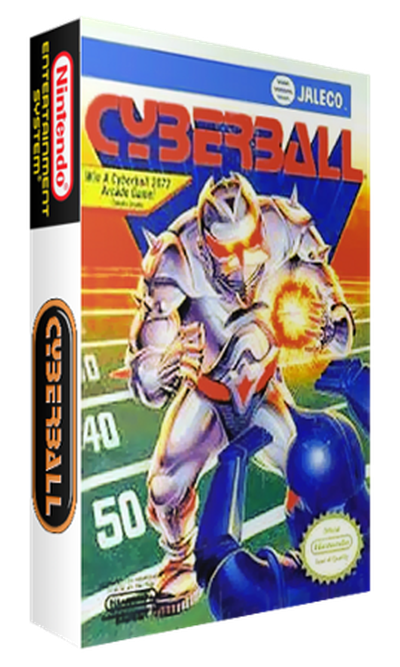
Cyberball
Descripción
Cyberball is an atari games arcade game of 7-man american football, using robotic avatars of different speeds, sizes, and skill sets. The game replaced the standard downs system with an explosive ball that progresses from "cool" to "warm", "hot", and "critical" status as it is used. Players can only defuse the ball, resetting it from its current state back to "cool" by crossing the 50 yard line or by change of possession, whether through touchdown, interception or fumble. A robot holding a critical ball while being tackled is destroyed along with the ball. The robots also possess finite durability. As offensive units are tackled, they wear down, finally issuing smoke and then flames after a number of hits. A flaming robot will explode when hit, thereby fumbling the ball. Players can upgrade robots with faster and more durable units using money bonuses they earn during play. Players select from run, pass or option plays on offense, after which the computer presents four individual plays from which to choose. On defense, a player can select short, medium or long defenses, and then select a specific defensive scheme. The standard cyberball cabinet consists of two monitors, each with two sets of controls for a maximum of four players, but atari games released single player and two player versions as well. The standard configuration allows single player, two player cooperative, two player head-to-head or four player head-to-head play. Playing with two teams of two persons opened up a new dimension of gameplay. Computer controlled avatars ran offensive patterns in very specific ways before reaching their assigned passing spots. Human players, however, could exploit the fact that a number of offensive plays started with identical formations. By choosing one play, but moving their avatars in imitation of a similar but different play, the offensive team could disguise their intentions before suddenly breaking for their assigned pass locations. This offensive flexibility forced defending players to quickly recognize plays and move to break them up by rushing to what they guessed was the intended passing spot. Most often, the timely use of the defender's turbo, a short-term speed boost usable once per play, would determine whether the play resulted in a missed pass, an interception, a long gain, or a score. This ability to improvise in four player mode built the popularity of cyberball, leading to many tournaments across the united states for a period of time. Cyberball was released for the nintendo entertainment system in 1992 by jaleco. Tengen intended to release it unlicensed, but jaleco purchased rights to publish it first. It has also been ported to numerous other platforms, including the commodore amiga, atari lynx and sega genesis.
Cyberball is an atari games arcade game of 7-man american football, using robotic avatars of different speeds, sizes, and skill sets. The game replaced the standard downs system with an explosive ball that progresses from "cool" to "warm", "hot", and "critical" status as it is used. Players can only defuse the ball, resetting it from its current state back to "cool" by crossing the 50 yard line or by change of possession, whether through touchdown, interception or fumble. A robot holding a critical ball while being tackled is destroyed along with the ball. The robots also possess finite durability. As offensive units are tackled, they wear down, finally issuing smoke and then flames after a number of hits. A flaming robot will explode when hit, thereby fumbling the ball. Players can upgrade robots with faster and more durable units using money bonuses they earn during play. Players select from run, pass or option plays on offense, after which the computer presents four individual plays from which to choose. On defense, a player can select short, medium or long defenses, and then select a specific defensive scheme. The standard cyberball cabinet consists of two monitors, each with two sets of controls for a maximum of four players, but atari games released single player and two player versions as well. The standard configuration allows single player, two player cooperative, two player head-to-head or four player head-to-head play. Playing with two teams of two persons opened up a new dimension of gameplay. Computer controlled avatars ran offensive patterns in very specific ways before reaching their assigned passing spots. Human players, however, could exploit the fact that a number of offensive plays started with identical formations. By choosing one play, but moving their avatars in imitation of a similar but different play, the offensive team could disguise their intentions before suddenly breaking for their assigned pass locations. This offensive flexibility forced defending players to quickly recognize plays and move to break them up by rushing to what they guessed was the intended passing spot. Most often, the timely use of the defender's turbo, a short-term speed boost usable once per play, would determine whether the play resulted in a missed pass, an interception, a long gain, or a score. This ability to improvise in four player mode built the popularity of cyberball, leading to many tournaments across the united states for a period of time. Cyberball was released for the nintendo entertainment system in 1992 by jaleco. Tengen intended to release it unlicensed, but jaleco purchased rights to publish it first. It has also been ported to numerous other platforms, including the commodore amiga, atari lynx and sega genesis.
Cyberball est un jeu d'arcade de jeux Atari de football américain à 7, utilisant des avatars robotiques de différentes vitesses, tailles et compétences. Le jeu a remplacé le système de downs standard par une balle explosive qui passe du statut « cool » à « chaud », « chaud » et « critique » au fur et à mesure de son utilisation. Les joueurs ne peuvent désamorcer le ballon, le remettant de son état actuel à "cool" qu'en franchissant la ligne des 50 mètres ou par changement de possession, que ce soit par touché, interception ou échappé. Un robot tenant une balle critique alors qu'il est plaqué est détruit avec la balle. Les robots possèdent également une durabilité limitée. Au fur et à mesure que les unités offensives sont attaquées, elles s'usent, émettant finalement de la fumée puis des flammes après un certain nombre de coups. Un robot enflammé explosera lorsqu'il sera touché, tâtonnant ainsi la balle. Les joueurs peuvent améliorer leurs robots avec des unités plus rapides et plus durables en utilisant les bonus en argent qu'ils gagnent pendant le jeu. Les joueurs choisissent parmi les jeux de course, de passe ou d'option en attaque, après quoi l'ordinateur présente quatre jeux individuels parmi lesquels choisir. En défense, un joueur peut sélectionner des défenses courtes, moyennes ou longues, puis sélectionner un schéma défensif spécifique. L'armoire cyberball standard se compose de deux moniteurs, chacun avec deux ensembles de commandes pour un maximum de quatre joueurs, mais les jeux Atari proposent également des versions solo et deux joueurs. La configuration standard permet un jeu en solo, en coopération à deux joueurs, en tête-à-tête à deux joueurs ou en tête-à-tête à quatre joueurs. Jouer avec deux équipes de deux personnes a ouvert une nouvelle dimension du gameplay. Les avatars contrôlés par ordinateur exécutaient des schémas offensifs de manière très spécifique avant d'atteindre les points de passage qui leur étaient assignés. Les joueurs humains pourraient cependant exploiter le fait qu’un certain nombre de jeux offensifs démarraient avec des formations identiques. En choisissant un jeu, mais en déplaçant ses avatars pour imiter un jeu similaire mais différent, l'équipe offensive pourrait dissimuler ses intentions avant de se précipiter soudainement vers les emplacements de passe qui lui ont été attribués. Cette flexibilité offensive a obligé les joueurs en défense à reconnaître rapidement les jeux et à les interrompre en se précipitant vers ce qu'ils devinaient être le point de passe prévu. Le plus souvent, l'utilisation opportune du turbo du défenseur, une augmentation de vitesse à court terme utilisable une fois par jeu, déterminerait si le jeu aboutissait à une passe manquée, une interception, un gain long ou un score. Cette capacité à improviser en mode quatre joueurs a construit la popularité du cyberball, conduisant à de nombreux tournois à travers les États-Unis pendant un certain temps. Cyberball est sorti sur le système de divertissement Nintendo en 1992 par Jaleco. Tengen avait l'intention de le publier sans licence, mais Jaleco a acheté les droits pour le publier en premier. Il a également été porté sur de nombreuses autres plates-formes, notamment le Commodore Amiga, Atari Lynx et Sega Genesis.
Cyberball è un gioco arcade Atari di football americano a 7 giocatori, che utilizza avatar robotici di diverse velocità, dimensioni e set di abilità. Il gioco ha sostituito il sistema di down standard con una palla esplosiva che passa dallo stato "freddo" a "caldo", "caldo" e "critico" man mano che viene utilizzato. I giocatori possono solo disinnescare la palla, riportandola dal suo stato attuale a "fredda" attraversando la linea delle 50 yard o cambiando possesso, sia tramite touchdown, intercettazione o fumble. Un robot che tiene in mano una palla critica mentre viene placcato viene distrutto insieme alla palla. I robot possiedono anche una durata limitata. Quando le unità offensive vengono affrontate, si logorano, emettendo infine fumo e poi fiamme dopo una serie di colpi. Un robot in fiamme esploderà quando viene colpito, facendo armeggiare la palla. I giocatori possono potenziare i robot con unità più veloci e durevoli utilizzando i bonus in denaro guadagnati durante il gioco. I giocatori scelgono tra corsa, passaggio o giocata opzionale in attacco, dopodiché il computer presenta quattro giocate individuali tra cui scegliere. In difesa, un giocatore può selezionare difese corte, medie o lunghe, quindi selezionare uno schema difensivo specifico. Il cabinet standard del cyberball è composto da due monitor, ciascuno con due set di controlli per un massimo di quattro giocatori, ma i giochi Atari hanno rilasciato anche versioni per giocatore singolo e per due giocatori. La configurazione standard consente il gioco per giocatore singolo, cooperativo per due giocatori, testa a testa per due giocatori o testa a testa per quattro giocatori. Giocare con due squadre di due persone ha aperto una nuova dimensione di gioco. Gli avatar controllati dal computer eseguivano schemi offensivi in modi molto specifici prima di raggiungere i punti di passaggio assegnati. I giocatori umani, tuttavia, potrebbero sfruttare il fatto che un certo numero di giochi offensivi sono iniziati con formazioni identiche. Scegliendo una giocata, ma spostando i propri avatar a imitazione di una giocata simile ma diversa, la squadra in attacco potrebbe mascherare le proprie intenzioni prima di dirigersi improvvisamente verso le posizioni di passaggio assegnate. Questa flessibilità offensiva ha costretto i giocatori in difesa a riconoscere rapidamente le giocate e a muoversi per interromperle correndo verso quello che immaginavano fosse il punto di passaggio previsto. Molto spesso, l'uso tempestivo del turbo del difensore, un aumento di velocità a breve termine utilizzabile una volta per giocata, determinerebbe se la giocata si è conclusa con un passaggio mancato, un'intercettazione, un guadagno lungo o un punteggio. Questa capacità di improvvisare in modalità a quattro giocatori ha creato la popolarità del cyberball, portando a molti tornei negli Stati Uniti per un periodo di tempo. Cyberball è stato rilasciato per Nintendo Entertainment System nel 1992 da Jaleco. Tengen intendeva rilasciarlo senza licenza, ma Jaleco ha acquistato prima i diritti per pubblicarlo. È stato anche portato su numerose altre piattaforme, tra cui Commodore Amiga, Atari Lynx e Sega Genesis.
Consejos
- Aprende las jugadas básicas.
- Cuidado con la energía de tus robots.
- El pase rápido es la clave.
- Juego de fútbol americano robótico; gestión de tiempo.
- No te quedes estático, muévete por el campo.
Consulta los trucos y consejos completos y siempre actualizados de este juego en la app.
Descargar gratis en Google Play- Learn the basic plays.
- Be careful with the energy of your robots.
- The quick pass is the key.
- Robotic football game; time management.
- Don't stay static, move around the field.
Consulta los trucos y consejos completos y siempre actualizados de este juego en la app.
Descargar gratis en Google Play- Apprenez les pièces de base.
- Soyez prudent avec l'énergie de vos robots.
- La passe rapide est la clé.
- Jeu de football robotisé ; gestion du temps.
- Ne restez pas statique, déplacez-vous sur le terrain.
Consulta los trucos y consejos completos y siempre actualizados de este juego en la app.
Descargar gratis en Google Play- Impara le giocate di base.
- Fai attenzione all'energia dei tuoi robot.
- Il passaggio veloce è la chiave.
- Gioco di calcio robotico; gestione del tempo.
- Non rimanere statico, muoviti per il campo.
Consulta los trucos y consejos completos y siempre actualizados de este juego en la app.
Descargar gratis en Google Play