
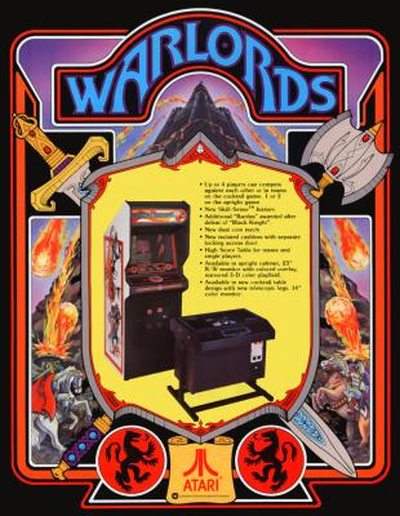
Warlords
Descripción
Atari's warlords depicts a third-person view of four castles. The player-controlled warlords and computer-controlled black knights use shields to defend their castle walls from the fireballs that ricochet around the playfield. Players can capture and catapult the fireballs at opposing castles, using their shield control and 'power stone' pushbutton. When a fireball hits a castle wall, it destroys one or more bricks, depending on its speed. A castle not paid for is controlled by the computer, with a black knight displayed in the appropriate castle. The black knights catapult fireballs at the players with increasing accuracy, to provide challenge. Game play begins when any start button is pressed and the countdown has ended. The game ends when the last warlord's castle (containing a crown) has been penetrated by a fireball. At this point a white cloud envelopes the crown, and the latter disappears. During the countdown, a dragon flies back and forth across the screen with a fireball in its mouth. At the end of the countdown, a position activated by a start button has its black knight changed to a warlord's crown. A position not activated remains as a black knight and is controlled by the computer. The dragon then spits the fireball from its mouth toward a warlord's castle. The objective is to destroy the three other castles, while protecting one's own castle with the moving shield. The led pushbuttons have dual functions: in the ready-to-play mode they work as start switches, and during game play they become 'power stones' to allow players to capture and catapult fireballs at opponents. The spinning fireballs released from a shield have more destructive force on a castle wall than a fireball simply deflected from another wall or the sides of the playfield. However, players will soon find out that they cannot hold onto a fireball for long, since it slowly destroys their own castle walls adjacent to the fireball. Additional fireballs appear at predetermined intervals or when a castle is destroyed, whichever comes first. A maximum of four fireballs simultaneously appear on the screen. In 1- and 2-player games, the warlords' crowns will be accompanied by a zero, to begin scoring. The point-scoring system is printed on each control panel (the black knights do not earn points). If a black knight has the surviving castle, the game ends. However, if a warlord has the surviving castle, that player receives bonus points, all castles are rebuilt, and the game continues with a new battle at a higher level. In a 2-player game, both players continue in the game, but only one player can get bonus points. If both black knights are eliminated first and only warlords remain, the level becomes a free-for-all between the two warlords until one is eliminated. The other warlord then gets the bonus points, and the game begins again. The subsequent levels begin, as mentioned before, with the fireball thrown out by the dragon. In the higher levels, black knights play more accurately and faster. 3- and 4-player games (available in the cocktail version only) are free-for-alls. No scores are kept, and the game ends as soon as there is only one castle left.
Atari's warlords depicts a third-person view of four castles. The player-controlled warlords and computer-controlled black knights use shields to defend their castle walls from the fireballs that ricochet around the playfield. Players can capture and catapult the fireballs at opposing castles, using their shield control and 'power stone' pushbutton. When a fireball hits a castle wall, it destroys one or more bricks, depending on its speed. A castle not paid for is controlled by the computer, with a black knight displayed in the appropriate castle. The black knights catapult fireballs at the players with increasing accuracy, to provide challenge. Game play begins when any start button is pressed and the countdown has ended. The game ends when the last warlord's castle (containing a crown) has been penetrated by a fireball. At this point a white cloud envelopes the crown, and the latter disappears. During the countdown, a dragon flies back and forth across the screen with a fireball in its mouth. At the end of the countdown, a position activated by a start button has its black knight changed to a warlord's crown. A position not activated remains as a black knight and is controlled by the computer. The dragon then spits the fireball from its mouth toward a warlord's castle. The objective is to destroy the three other castles, while protecting one's own castle with the moving shield. The led pushbuttons have dual functions: in the ready-to-play mode they work as start switches, and during game play they become 'power stones' to allow players to capture and catapult fireballs at opponents. The spinning fireballs released from a shield have more destructive force on a castle wall than a fireball simply deflected from another wall or the sides of the playfield. However, players will soon find out that they cannot hold onto a fireball for long, since it slowly destroys their own castle walls adjacent to the fireball. Additional fireballs appear at predetermined intervals or when a castle is destroyed, whichever comes first. A maximum of four fireballs simultaneously appear on the screen. In 1- and 2-player games, the warlords' crowns will be accompanied by a zero, to begin scoring. The point-scoring system is printed on each control panel (the black knights do not earn points). If a black knight has the surviving castle, the game ends. However, if a warlord has the surviving castle, that player receives bonus points, all castles are rebuilt, and the game continues with a new battle at a higher level. In a 2-player game, both players continue in the game, but only one player can get bonus points. If both black knights are eliminated first and only warlords remain, the level becomes a free-for-all between the two warlords until one is eliminated. The other warlord then gets the bonus points, and the game begins again. The subsequent levels begin, as mentioned before, with the fireball thrown out by the dragon. In the higher levels, black knights play more accurately and faster. 3- and 4-player games (available in the cocktail version only) are free-for-alls. No scores are kept, and the game ends as soon as there is only one castle left.
Les seigneurs de guerre d'Atari représentent une vue à la troisième personne de quatre châteaux. Les seigneurs de guerre contrôlés par les joueurs et les chevaliers noirs contrôlés par ordinateur utilisent des boucliers pour défendre les murs de leur château contre les boules de feu qui ricochent autour du terrain de jeu. Les joueurs peuvent capturer et catapulter les boules de feu sur les châteaux adverses, en utilisant leur contrôle de bouclier et leur bouton-poussoir « pierre de puissance ». Lorsqu'une boule de feu frappe un mur de château, elle détruit une ou plusieurs briques, en fonction de sa vitesse. Un château non payé est contrôlé par l'ordinateur, avec un chevalier noir affiché dans le château approprié. Les chevaliers noirs catapultent des boules de feu sur les joueurs avec une précision croissante, pour créer un défi. Le jeu commence lorsqu'un bouton de démarrage est enfoncé et que le compte à rebours est terminé. Le jeu se termine lorsque le château du dernier seigneur de guerre (contenant une couronne) a été pénétré par une boule de feu. A ce moment un nuage blanc enveloppe la couronne et celle-ci disparaît. Pendant le compte à rebours, un dragon vole d'avant en arrière sur l'écran avec une boule de feu dans la gueule. A la fin du compte à rebours, une position activée par un bouton de démarrage voit son chevalier noir changé en couronne de seigneur de guerre. Une position non activée reste en tant que chevalier noir et est contrôlée par l'ordinateur. Le dragon crache ensuite la boule de feu depuis sa bouche vers le château d'un seigneur de guerre. L'objectif est de détruire les trois autres châteaux, tout en protégeant son propre château avec le bouclier mobile. Les boutons-poussoirs LED ont une double fonction : en mode prêt à jouer, ils fonctionnent comme des interrupteurs de démarrage et pendant le jeu, ils deviennent des « pierres de puissance » pour permettre aux joueurs de capturer et de catapulter des boules de feu sur les adversaires. Les boules de feu en rotation libérées par un bouclier ont une force plus destructrice sur un mur de château qu'une boule de feu simplement déviée d'un autre mur ou des côtés du terrain de jeu. Cependant, les joueurs découvriront bientôt qu'ils ne peuvent pas retenir longtemps une boule de feu, car elle détruit lentement les murs de leur propre château adjacents à la boule de feu. Des boules de feu supplémentaires apparaissent à des intervalles prédéterminés ou lorsqu'un château est détruit, selon la première éventualité. Un maximum de quatre boules de feu apparaissent simultanément sur l'écran. Dans les parties à 1 et 2 joueurs, les couronnes des seigneurs de guerre seront accompagnées d'un zéro pour commencer le décompte. Le système de pointage est imprimé sur chaque panneau de contrôle (les chevaliers noirs ne gagnent pas de points). Si un chevalier noir possède le château survivant, la partie se termine. Cependant, si un chef de guerre possède le château survivant, ce joueur reçoit des points bonus, tous les châteaux sont reconstruits et le jeu continue avec une nouvelle bataille à un niveau supérieur. Dans une partie à 2 joueurs, les deux joueurs continuent de jouer, mais un seul joueur peut obtenir des points bonus. Si les deux chevaliers noirs sont éliminés en premier et qu'il ne reste que des seigneurs de guerre, le niveau devient une bagarre entre les deux seigneurs de guerre jusqu'à ce que l'un d'entre eux soit éliminé. L'autre chef de guerre obtient alors les points bonus et le jeu recommence. Les niveaux suivants commencent, comme mentionné précédemment, avec la boule de feu lancée par le dragon. Dans les niveaux supérieurs, les chevaliers noirs jouent avec plus de précision et de rapidité. Les jeux à 3 et 4 joueurs (disponibles uniquement en version cocktail) sont gratuits pour tous. Aucun score n'est comptabilisé et le jeu se termine dès qu'il ne reste plus qu'un château.
I signori della guerra di Atari raffigura una visuale in terza persona di quattro castelli. I signori della guerra controllati dal giocatore e i cavalieri neri controllati dal computer usano gli scudi per difendere le mura del loro castello dalle palle di fuoco che rimbalzano sul campo di gioco. I giocatori possono catturare e catapultare le palle di fuoco nei castelli avversari, usando il controllo dello scudo e il pulsante "pietra del potere". Quando una palla di fuoco colpisce le mura del castello, distrugge uno o più mattoni, a seconda della sua velocità. Un castello non pagato è controllato dal computer, con un cavaliere nero visualizzato nel castello appropriato. I cavalieri neri catapultano palle di fuoco contro i giocatori con crescente precisione, per fornire sfida. Il gioco inizia quando viene premuto un pulsante di avvio e il conto alla rovescia è terminato. Il gioco termina quando il castello dell'ultimo signore della guerra (contenente una corona) è stato penetrato da una palla di fuoco. A questo punto una nuvola bianca avvolge la corona, e quest'ultima scompare. Durante il conto alla rovescia, un drago vola avanti e indietro sullo schermo con una palla di fuoco in bocca. Alla fine del conto alla rovescia, una posizione attivata da un pulsante di avvio vede il suo cavaliere nero cambiato nella corona di un signore della guerra. Una posizione non attivata rimane come cavaliere nero ed è controllata dal computer. Il drago poi sputa la palla di fuoco dalla bocca verso il castello di un signore della guerra. L'obiettivo è distruggere gli altri tre castelli, proteggendo al tempo stesso il proprio castello con lo scudo mobile. I pulsanti led hanno una doppia funzione: nella modalità ready-to-play funzionano come interruttori di avvio e durante il gioco diventano "pietre del potere" per consentire ai giocatori di catturare e catapultare palle di fuoco contro gli avversari. Le palle di fuoco rotanti rilasciate da uno scudo hanno una forza più distruttiva sulle mura del castello rispetto a una palla di fuoco semplicemente deviata da un altro muro o dai lati del campo di gioco. Tuttavia, i giocatori scopriranno presto che non possono trattenere a lungo una palla di fuoco, poiché distrugge lentamente le mura del loro castello adiacenti alla palla di fuoco. Ulteriori palle di fuoco appaiono a intervalli predeterminati o quando un castello viene distrutto, a seconda di quale evento si verifica per primo. Sullo schermo appaiono contemporaneamente un massimo di quattro palle di fuoco. Nelle partite a 1 e 2 giocatori, le corone dei signori della guerra saranno accompagnate da uno zero, per iniziare a contare. Il sistema di punteggio è stampato su ogni pannello di controllo (i cavalieri neri non guadagnano punti). Se un cavaliere nero possiede il castello sopravvissuto, il gioco finisce. Tuttavia, se un signore della guerra ha il castello sopravvissuto, quel giocatore riceve punti bonus, tutti i castelli vengono ricostruiti e il gioco continua con una nuova battaglia a un livello superiore. In una partita a 2 giocatori, entrambi i giocatori continuano il gioco, ma solo un giocatore può ottenere punti bonus. Se entrambi i cavalieri neri vengono eliminati per primi e rimangono solo i signori della guerra, il livello diventa un tutti contro tutti tra i due signori della guerra finché non ne viene eliminato uno. L'altro signore della guerra ottiene quindi i punti bonus e il gioco ricomincia. I livelli successivi iniziano, come accennato prima, con la palla di fuoco lanciata dal drago. Nei livelli più alti, i cavalieri neri giocano in modo più preciso e veloce. I giochi a 3 e 4 giocatori (disponibili solo nella versione cocktail) sono gratuiti per tutti. Non viene tenuto alcun punteggio e il gioco termina non appena rimane un solo castello.
Consejos
- Mantén el escudo cerca de la esquina; es donde más rebota la bola.
Consulta los trucos y consejos completos y siempre actualizados de este juego en la app.
- Keep the shield close to the corner; It is where the ball bounces the most.
Consulta los trucos y consejos completos y siempre actualizados de este juego en la app.
- Gardez le bouclier près du coin ; C'est là que la balle rebondit le plus.
Consulta los trucos y consejos completos y siempre actualizados de este juego en la app.
- Tieni lo scudo vicino all'angolo; È il punto in cui la palla rimbalza di più.
Consulta los trucos y consejos completos y siempre actualizados de este juego en la app.