Igo - Kyuu Roban Taikyoku
Descripción
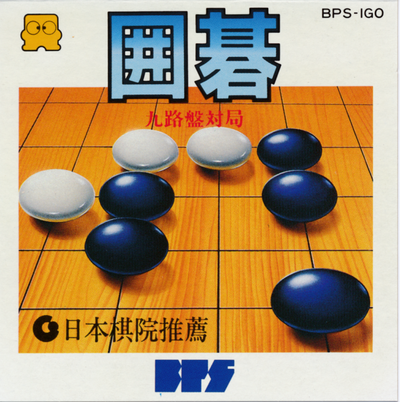
Igo: kyuu roban taikyoku is the first real attempt to bring the japanese board game go to a home console, namely the famicom. The game was designed by henk rogers, a dutch programmer who would play games of go against the ceo (at the time) of nintendo, hiroshi yamauchi. It was during one such game that the prospect of developing such a title for the famicom was discussed. It was later converted from disk format to cartridge and release in august 1987. Prior to the release of this game, nintendo had released a game which was played on the go board in 1983, known as gomoku narabe renju, but the play mechanics were more akin to "connect four" (or five, as it were). The real game of go is traditionally played on a 19 ã— 19 grid, but the permutations of possibilities would take too long for the famicom's processor to consider, so the board size has been significantly reduced to a 9 ã— 9 grid, which allows for a smoother single player experience. The game also features a lesson mode, in which ninjas appear to teach the player about the rules and strategy of the game.
Igo: kyuu roban taikyoku is the first real attempt to bring the japanese board game go to a home console, namely the famicom. The game was designed by henk rogers, a dutch programmer who would play games of go against the ceo (at the time) of nintendo, hiroshi yamauchi. It was during one such game that the prospect of developing such a title for the famicom was discussed. It was later converted from disk format to cartridge and release in august 1987. Prior to the release of this game, nintendo had released a game which was played on the go board in 1983, known as gomoku narabe renju, but the play mechanics were more akin to "connect four" (or five, as it were). The real game of go is traditionally played on a 19 ã— 19 grid, but the permutations of possibilities would take too long for the famicom's processor to consider, so the board size has been significantly reduced to a 9 ã— 9 grid, which allows for a smoother single player experience. The game also features a lesson mode, in which ninjas appear to teach the player about the rules and strategy of the game.
Igo : kyuu roban taikyoku est la première véritable tentative d'amener le jeu de société japonais sur une console de salon, à savoir la famicom. Le jeu a été conçu par Henk Rogers, un programmeur néerlandais qui jouait à des jeux de go contre le PDG (à l'époque) de Nintendo, Hiroshi Yamauchi. C'est lors d'un de ces jeux que la perspective de développer un tel titre pour la famicom a été évoquée. Il a ensuite été converti du format disque en cartouche et sorti en août 1987. Avant la sortie de ce jeu, Nintendo avait sorti un jeu qui se jouait sur le plateau Go en 1983, connu sous le nom de gomoku narabe renju, mais les mécanismes de jeu s'apparentaient davantage à "connecter quatre" (ou cinq, pour ainsi dire). Le vrai jeu de go se joue traditionnellement sur une grille de 19 × 19, mais les permutations des possibilités prendraient trop de temps à prendre en compte par le processeur de la famicom, c'est pourquoi la taille du plateau a été considérablement réduite à une grille de 9 × 9, ce qui permet une expérience solo plus fluide. Le jeu propose également un mode leçon, dans lequel des ninjas apparaissent pour enseigner au joueur les règles et la stratégie du jeu.
Igo: kyuu roban taikyoku è il primo vero tentativo di portare il gioco da tavolo giapponese su una console domestica, ovvero famicom. Il gioco è stato progettato da Henk Rogers, un programmatore olandese che giocava a Go contro l'amministratore delegato (all'epoca) di Nintendo, Hiroshi Yamauchi. Fu durante uno di questi giochi che venne discussa la prospettiva di sviluppare un titolo del genere per famicom. Successivamente fu convertito dal formato disco a cartuccia e rilasciato nell'agosto 1987. Prima dell'uscita di questo gioco, Nintendo aveva rilasciato un gioco che veniva giocato sul go board nel 1983, noto come gomoku narabe renju, ma i meccanismi di gioco erano più simili a "collegare quattro" (o cinque, per così dire). Il vero gioco del go è tradizionalmente giocato su una griglia 19 × 19, ma le permutazioni delle possibilità richiederebbero troppo tempo per essere prese in considerazione dal processore di famicom, quindi la dimensione del tabellone è stata significativamente ridotta a una griglia 9 × 9, che consente un'esperienza per giocatore singolo più fluida. Il gioco presenta anche una modalità lezione, in cui i ninja sembrano insegnare al giocatore le regole e la strategia del gioco.
Consejos
- Desbloquea el modo experto.
- El contrincante no mueve.
- El tablero se llena con tu color.
- Gana siempre con un botón.
- Pulsa Select para ganar la partida.
- La invencibilidad de las piezas.
Consulta los trucos y consejos completos y siempre actualizados de este juego en la app.
Descargar gratis en Google Play- Unlock expert mode.
- The opponent does not move.
- The board fills with your color.
- Always win with one button.
- Press Select to win the game.
- The invincibility of the pieces.
Consulta los trucos y consejos completos y siempre actualizados de este juego en la app.
Descargar gratis en Google Play- Débloquez le mode expert.
- L'adversaire ne bouge pas.
- Le tableau se remplit de votre couleur.
- Gagnez toujours avec un seul bouton.
- Appuyez sur Sélectionner pour gagner la partie.
- L'invincibilité des pièces.
Consulta los trucos y consejos completos y siempre actualizados de este juego en la app.
Descargar gratis en Google Play- Sblocca la modalità esperto.
- L'avversario non si muove.
- Il tabellone si riempie del tuo colore.
- Vinci sempre con un pulsante.
- Premi Seleziona per vincere la partita.
- L'invincibilità dei pezzi.
Consulta los trucos y consejos completos y siempre actualizados de este juego en la app.
Descargar gratis en Google Play