
Gyruss
Descripción
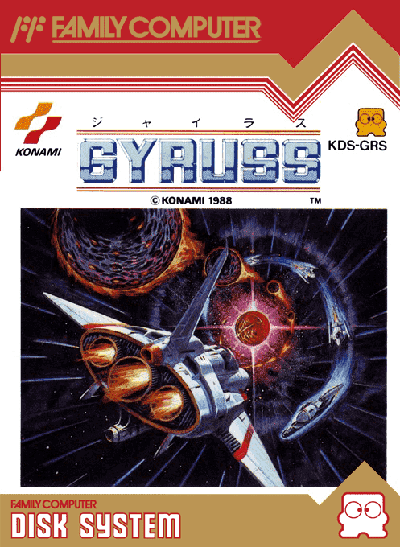
Gyruss is a shoot 'em up arcade game designed by yoshiki okamoto and released by konami in 1983. The majority of enemies are spaceships, which must be destroyed to complete a level. They appear either from the centre of the screen or from one of the edges, and move in swirling patterns. They can shoot the player's ship or destroy it by contact. They hover near the centre of the screen after completing their deployment pattern, and occasionally fly outwards and shoot at the player. If not destroyed by the player, the enemy ships gradually fly away one by one. The gameplay is similar to that of galaga but presented in a forced 3d perspective, with the player's ship facing 'into' the screen and able to move around the perimeter of an implicit circle. The scrolling starfield of earlier space shooter games is arranged to fit the 3d perspective, with the stars coming into view at the centre of the screen and flying outward, giving the impression of the player's ship moving through space. Gyruss was also remade for the family computer disk system in japan, and later the nintendo entertainment system in north america, released by konami's subsidiary ultra games. In these versions of the game, the core gameplay is still largely the same, but there are several major revisions. The game was well received in north america. Revisions include: updated graphics additional control options the music from the arcade version of the game was slightly remixed, and several additional tracks composed by atsushi fujio, yuichi sakakura, and harumi ueko were added. The player starts off at "three warps to neptune" instead of "two warps" the player can use a super phaser attack in addition to the normal guns there are additional enemies, including boss fights when the player reaches each planet bonus stages after each planet's boss is defeated, for a chance to gain additional powerups there is a definite ending to the game. In the nes version, it's a brief text about the universe being at peace. In the fds version, there is a full ending sequence with credits. In addition to the satellites providing the usual double guns and bonus points, they can also provide extra phasers, a smart bomb, and even an extra life instead of the arcade's looping 24 stages, there are 39 looping. In the arcade, the player starts from neptune and proceeds to earth. On the nes version, the player travels through the entire solar system, including neptune, pluto, uranus, saturn, jupiter, mars, earth, venus, mercury, and the sun. The player can enter the konami code at the title screen for extra lives, but with a twist: the code must be entered in reverse (a-b-a-b-right-left-right-left-down-down-up-up) instead of in the original sequence.
Gyruss is a shoot 'em up arcade game designed by yoshiki okamoto and released by konami in 1983. The majority of enemies are spaceships, which must be destroyed to complete a level. They appear either from the centre of the screen or from one of the edges, and move in swirling patterns. They can shoot the player's ship or destroy it by contact. They hover near the centre of the screen after completing their deployment pattern, and occasionally fly outwards and shoot at the player. If not destroyed by the player, the enemy ships gradually fly away one by one. The gameplay is similar to that of galaga but presented in a forced 3d perspective, with the player's ship facing 'into' the screen and able to move around the perimeter of an implicit circle. The scrolling starfield of earlier space shooter games is arranged to fit the 3d perspective, with the stars coming into view at the centre of the screen and flying outward, giving the impression of the player's ship moving through space. Gyruss was also remade for the family computer disk system in japan, and later the nintendo entertainment system in north america, released by konami's subsidiary ultra games. In these versions of the game, the core gameplay is still largely the same, but there are several major revisions. The game was well received in north america. Revisions include: updated graphics additional control options the music from the arcade version of the game was slightly remixed, and several additional tracks composed by atsushi fujio, yuichi sakakura, and harumi ueko were added. The player starts off at "three warps to neptune" instead of "two warps" the player can use a super phaser attack in addition to the normal guns there are additional enemies, including boss fights when the player reaches each planet bonus stages after each planet's boss is defeated, for a chance to gain additional powerups there is a definite ending to the game. In the nes version, it's a brief text about the universe being at peace. In the fds version, there is a full ending sequence with credits. In addition to the satellites providing the usual double guns and bonus points, they can also provide extra phasers, a smart bomb, and even an extra life instead of the arcade's looping 24 stages, there are 39 looping. In the arcade, the player starts from neptune and proceeds to earth. On the nes version, the player travels through the entire solar system, including neptune, pluto, uranus, saturn, jupiter, mars, earth, venus, mercury, and the sun. The player can enter the konami code at the title screen for extra lives, but with a twist: the code must be entered in reverse (a-b-a-b-right-left-right-left-down-down-up-up) instead of in the original sequence.
Gyruss est un jeu d'arcade shoot'em up conçu par Yoshiki Okamoto et sorti par Konami en 1983. La majorité des ennemis sont des vaisseaux spatiaux, qui doivent être détruits pour terminer un niveau. Ils apparaissent soit depuis le centre de l'écran, soit depuis l'un des bords, et se déplacent selon des motifs tourbillonnants. Ils peuvent tirer sur le vaisseau du joueur ou le détruire par contact. Ils planent près du centre de l'écran après avoir terminé leur schéma de déploiement, et volent parfois vers l'extérieur et tirent sur le joueur. S'ils ne sont pas détruits par le joueur, les navires ennemis s'envolent progressivement un à un. Le gameplay est similaire à celui de Galaga mais présenté dans une perspective 3D forcée, avec le vaisseau du joueur face « vers » l'écran et capable de se déplacer autour du périmètre d'un cercle implicite. Le champ d'étoiles défilant des premiers jeux de tir spatial est agencé pour s'adapter à la perspective 3D, les étoiles apparaissant au centre de l'écran et volant vers l'extérieur, donnant l'impression que le vaisseau du joueur se déplace dans l'espace. Gyruss a également été refait pour le système de disque informatique familial au Japon, et plus tard pour le système de divertissement Nintendo en Amérique du Nord, publié par Ultra Games, la filiale de Konami. Dans ces versions du jeu, le gameplay de base est toujours en grande partie le même, mais il y a plusieurs révisions majeures. Le jeu a été bien accueilli en Amérique du Nord. Les révisions incluent : des graphismes mis à jour des options de contrôle supplémentaires la musique de la version arcade du jeu a été légèrement remixée et plusieurs pistes supplémentaires composées par Atsushi Fujio, Yuichi Sakakura et Harumi ueko ont été ajoutées. Le joueur commence à "trois chaînes vers Neptune" au lieu de "deux chaînes", le joueur peut utiliser une attaque super phaser en plus des armes normales, il y a des ennemis supplémentaires, y compris des combats de boss lorsque le joueur atteint les étapes bonus de chaque planète après la défaite du boss de chaque planète, pour avoir une chance d'obtenir des bonus supplémentaires, il y a une fin définitive au jeu. Dans la version nes, il s'agit d'un bref texte sur l'univers en paix. Dans la version fds, il y a une séquence de fin complète avec des crédits. En plus des satellites fournissant les doubles canons et les points bonus habituels, ils peuvent également fournir des phaseurs supplémentaires, une bombe intelligente et même une vie supplémentaire au lieu des 24 niveaux de boucle de l'arcade, il y en a 39. Dans l'arcade, le joueur part de Neptune et se dirige vers la Terre. Sur la version Nintendo, le joueur voyage à travers tout le système solaire, y compris Neptune, Pluton, Uranus, Saturne, Jupiter, Mars, la Terre, Vénus, Mercure et le Soleil. Le joueur peut saisir le code Konami sur l'écran titre pour des vies supplémentaires, mais avec une particularité : le code doit être saisi à l'envers (a-b-a-b-droite-gauche-droite-gauche-bas-bas-haut-haut) au lieu de dans la séquence d'origine.
Gyruss è un gioco arcade sparatutto progettato da Yoshiki Okamoto e pubblicato da Konami nel 1983. La maggior parte dei nemici sono astronavi, che devono essere distrutte per completare un livello. Appaiono dal centro dello schermo o da uno dei bordi e si muovono secondo schemi vorticosi. Possono sparare alla nave del giocatore o distruggerla per contatto. Si librano vicino al centro dello schermo dopo aver completato lo schema di schieramento e occasionalmente volano verso l'esterno e sparano al giocatore. Se non vengono distrutte dal giocatore, le navi nemiche volano via gradualmente una alla volta. Il gameplay è simile a quello di Galaga ma presentato in una prospettiva 3D forzata, con la nave del giocatore rivolta "dentro" lo schermo e in grado di muoversi attorno al perimetro di un cerchio implicito. Il campo stellare a scorrimento dei precedenti giochi sparatutto spaziali è organizzato per adattarsi alla prospettiva 3D, con le stelle che appaiono al centro dello schermo e volano verso l'esterno, dando l'impressione che la nave del giocatore si muova nello spazio. Gyruss è stato anche rifatto per il sistema disco del computer di famiglia in Giappone, e successivamente per il sistema di intrattenimento Nintendo in Nord America, rilasciato dalla filiale di Konami Ultra Games. In queste versioni del gioco, il gameplay principale è ancora sostanzialmente lo stesso, ma sono state apportate diverse revisioni importanti. Il gioco è stato ben accolto in Nord America. Le revisioni includono: grafica aggiornata, opzioni di controllo aggiuntive, la musica della versione arcade del gioco è stata leggermente remixata e sono state aggiunte diverse tracce aggiuntive composte da atsushi fujio, yuichi sakakura e harumi ueko. Il giocatore inizia con "tre curvature verso Nettuno" invece che con "due curvature", il giocatore può usare un attacco superphaser in aggiunta alle normali pistole ci sono nemici aggiuntivi, inclusi combattimenti contro i boss quando il giocatore raggiunge le fasi bonus di ogni pianeta dopo che il boss di ogni pianeta è stato sconfitto, per avere la possibilità di ottenere potenziamenti aggiuntivi c'è un finale definito per il gioco. Nella versione nes, è un breve testo sull'universo in pace. Nella versione fds c'è una sequenza finale completa di titoli di coda. Oltre ai satelliti che forniscono le solite doppie armi e punti bonus, possono anche fornire faser extra, una bomba intelligente e persino una vita extra invece dei 24 livelli in loop della sala giochi, ce ne sono 39. Nella sala giochi, il giocatore inizia da Nettuno e procede verso la Terra. Nella versione Nes, il giocatore viaggia attraverso l'intero sistema solare, inclusi Nettuno, Plutone, Urano, Saturno, Giove, Marte, Terra, Venere, Mercurio e il Sole. Il giocatore può inserire il codice Konami nella schermata del titolo per ottenere vite extra, ma con una novità: il codice deve essere inserito al contrario (a-b-a-b-destra-sinistra-destra-sinistra-giù-giù-su-su) invece che nella sequenza originale.
Consejos
- El disparo doble es permanente.
- La nave se mueve a velocidad luz.
- Los jefes explotan al aparecer.
- Gana puntos infinitos.
- La invencibilidad frente a enemigos.
- Pulsa Select para vidas infinitas.
Consulta los trucos y consejos completos y siempre actualizados de este juego en la app.
Descargar gratis en Google Play- The double shot is permanent.
- The ship is moving at light speed.
- Bosses explode when they appear.
- Earn infinite points.
- Invincibility against enemies.
- Press Select for infinite lives.
Consulta los trucos y consejos completos y siempre actualizados de este juego en la app.
Descargar gratis en Google Play- Le double coup est permanent.
- Le navire se déplace à la vitesse de la lumière.
- Les boss explosent lorsqu'ils apparaissent.
- Gagnez des points infinis.
- Invincibilité contre les ennemis.
- Appuyez sur Select pour des vies infinies.
Consulta los trucos y consejos completos y siempre actualizados de este juego en la app.
Descargar gratis en Google Play- Il doppio colpo è permanente.
- La nave si muove alla velocità della luce.
- I boss esplodono quando appaiono.
- Guadagna infiniti punti.
- Invincibilità contro i nemici.
- Premi Seleziona per vite infinite.
Consulta los trucos y consejos completos y siempre actualizados de este juego en la app.
Descargar gratis en Google Play